




Review of
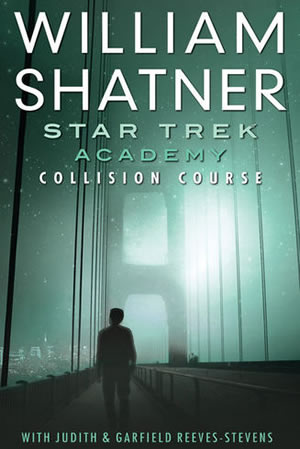
Academy: Collision Course
Published:
October 2007
Reviewer Rating:
Avg User Rating:
(3.74)

Two teenagers meet when they follow separate mysteries that lead to Starfleet Academy in San Francisco. Jim Kirk is a rebellious young man with a troubled past he's trying to overcome, and Spock is a Vulcan trying to find his place. But when these two come together, they just may be more than either one is alone.
This book isn't really considered "Star Trek Canon" in any way, but more of William Shatner's personal backstory on these iconic characters and the universe around them. Once again, Shatner is aided by Star Trek veterans Judith and Garfield Reeves-Stevens, who have assisted him in all of his previous Trek novels. They bring a credibility and experience that helps shape and define the story beyond Shatner's original ideas.
I didn't love the idea that Jim Kirk was some sort of technical genius in engineering and capable of whipping up high tech gadgets in his garage, so this book started off on the wrong foot with me. I decided to roll with it and put that aside, but it kept coming back even after other facets of Kirk's personality were more worth focusing on. While Kirk has a girlfriend in the book (whom he is actively trying to get out of hot water with Starfleet) he still has time to flirt and even pull something of a Mrs. Robinson moment late in the book.
The most compelling thing about Kirk in this book is his constant animosity towards Starfleet - in fact, you almost feel like there's no way he'll ever want to join up. But connecting his feelings to the classic Trek episode The Conscience of the King was clever and really brought things together. Kirk's issues resulting from that backstory provided an interesting plot complication for him to overcome throughout the novel.
I felt Spock actually faired better than Kirk in this book. He felt much more in character with dialogue and actions. And while it presents another version of how he enlisted in Starfleet, it still showed his intelligence, desire to explore his human side, and a small degree of rebelliousness that is always nice to see in a young Spock. His investigations of thefts at the Vulcan consulate made sense to me as it was all part of his boredom and desire to grow beyond the expectations of his father. Nicely done and presented throughout the book.
While the main "bad guys" are from Kirk's past on Tarsus IV for the most part, their overall plot didn't really make sense to me. It was fairly convoluted and didn't really have a big purpose making this all seem like a really long novel for younger readers. I understand that it's hard to come up with something believable and workable for teenage characters, but I found myself losing interest several times throughout the book. I'd put it down for a little while and come back to it when I was in the right mind frame. Honestly, the first three quarters of the book were a bit of a slog, but the final hundred pages were fun - if a little over the top. Again, it all felt like a young readers book.
For deep fans, there are several references to Enterprise throughout the book, and a few obscure characters who will appear later in Star Trek canon, but not too many Easter Eggs or amazing cameos here. I did find it interesting that we see the starship Enterprise at a point between her first five-year mission under Robert April, and her second with Christopher Pike. Its kind of an interesting little niche that kind of explains some differences between the original pilot and the ultimate Star Trek original series.
Overall, this isn't a home run of a novel, but it's a solid single that most fans will find something to like while reading.
This book isn't really considered "Star Trek Canon" in any way, but more of William Shatner's personal backstory on these iconic characters and the universe around them. Once again, Shatner is aided by Star Trek veterans Judith and Garfield Reeves-Stevens, who have assisted him in all of his previous Trek novels. They bring a credibility and experience that helps shape and define the story beyond Shatner's original ideas.
I didn't love the idea that Jim Kirk was some sort of technical genius in engineering and capable of whipping up high tech gadgets in his garage, so this book started off on the wrong foot with me. I decided to roll with it and put that aside, but it kept coming back even after other facets of Kirk's personality were more worth focusing on. While Kirk has a girlfriend in the book (whom he is actively trying to get out of hot water with Starfleet) he still has time to flirt and even pull something of a Mrs. Robinson moment late in the book.
The most compelling thing about Kirk in this book is his constant animosity towards Starfleet - in fact, you almost feel like there's no way he'll ever want to join up. But connecting his feelings to the classic Trek episode The Conscience of the King was clever and really brought things together. Kirk's issues resulting from that backstory provided an interesting plot complication for him to overcome throughout the novel.
I felt Spock actually faired better than Kirk in this book. He felt much more in character with dialogue and actions. And while it presents another version of how he enlisted in Starfleet, it still showed his intelligence, desire to explore his human side, and a small degree of rebelliousness that is always nice to see in a young Spock. His investigations of thefts at the Vulcan consulate made sense to me as it was all part of his boredom and desire to grow beyond the expectations of his father. Nicely done and presented throughout the book.
While the main "bad guys" are from Kirk's past on Tarsus IV for the most part, their overall plot didn't really make sense to me. It was fairly convoluted and didn't really have a big purpose making this all seem like a really long novel for younger readers. I understand that it's hard to come up with something believable and workable for teenage characters, but I found myself losing interest several times throughout the book. I'd put it down for a little while and come back to it when I was in the right mind frame. Honestly, the first three quarters of the book were a bit of a slog, but the final hundred pages were fun - if a little over the top. Again, it all felt like a young readers book.
For deep fans, there are several references to Enterprise throughout the book, and a few obscure characters who will appear later in Star Trek canon, but not too many Easter Eggs or amazing cameos here. I did find it interesting that we see the starship Enterprise at a point between her first five-year mission under Robert April, and her second with Christopher Pike. Its kind of an interesting little niche that kind of explains some differences between the original pilot and the ultimate Star Trek original series.
Overall, this isn't a home run of a novel, but it's a solid single that most fans will find something to like while reading.